
-
NOPNANews
nopna.org A Publication of the North of Panhandle Neighborhood Association
Summer 2023
by Leela Gill
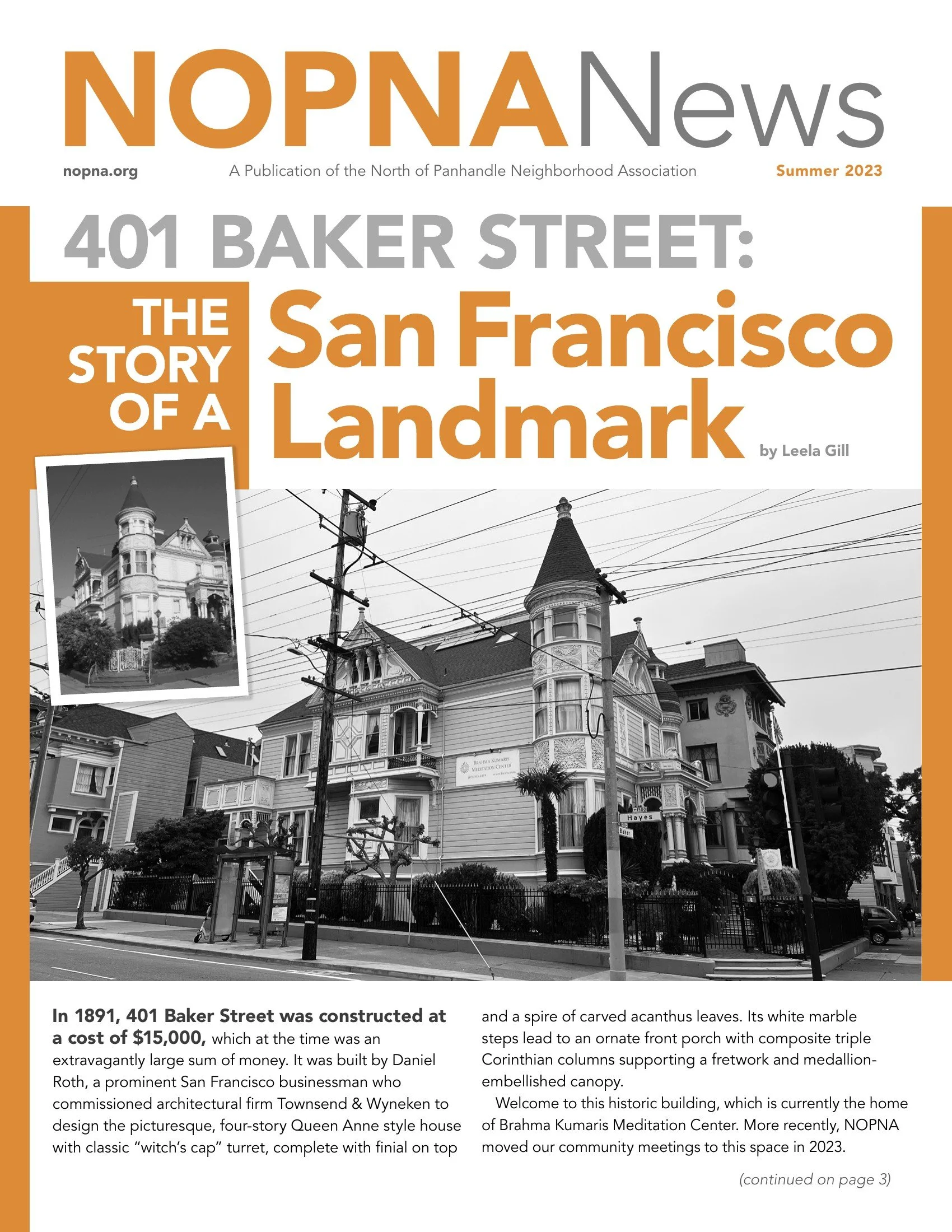
In 1891, 401 Baker Street was constructed at
a cost of $15,000, which at the time was an
extravagantly large sum of money. It was built by Daniel
Roth, a prominent San Francisco businessman who
commissioned architectural firm Townsend & Wyneken to
design the picturesque, four-story Queen Anne style house
with classic “witch’s cap” turret, complete with finial on top
and a spire of carved acanthus leaves. Its white marble
steps lead to an ornate front porch with composite triple
Corinthian columns supporting a fretwork and medallion-
embellished canopy.
Welcome to this historic building, which is currently the home
of Brahma Kumaris Meditation Center. More recently, NOPNA
moved our community meetings to this space in 2023.
(continued on page 3)
2 | NOPNANews
FROM THE BOARD
MEDITATING ON
NOPNA HAPPENINGS
Martin Almaraz
NOPNA President
On April 20, NOPNA
hosted a community
meeting at Brahma Kumaris
Meditation Center for the
first time. We focused the
meeting on two topics:
homelessness and safety.
We had a stellar speaker
line-up including District
2 Supervisor Catherine
Stefani, MyOwnLockandKey.
org leader Alex Tourk, and Bay to Breakers representative Kyle Meyers.
After San Francisco’s 2022 supervisorial redistricting, District 2 Supervisor
Stefani became the representative for about half of NOPA’s residents. She
spoke about her office’s efforts to clean up the streets around City Center
and explained that limited San Francisco Police Department resources have
made it difficult to help people experiencing homelessness. We’ve also heard
this from District 5 Supervisor Dean Preston and from Emily Cohen, director
of the Department of Homelessness and Supportive Housing. NOPNA will
continue to push for progress on these topics and will share updates from
these departments.
Alex Tourk, former deputy chief of staff to Governor Gavin Newsom-
turned-homelessness solution seeker, offered the idea of “tiny homes” for
the unhoused. If done well, this can be a low cost, safe, and more humane
alternative to the current San Francisco Navigation Centers. Alex noted that tiny
homes provide a sense of security and stability, having their own “lock and key.”
You can learn more by going to their website at myownlockandkey.org.
Rounding out our community meeting agenda, Kyle Meyers from Bay to
Breakers discussed updates for this year’s 12k race and reported that Bay to
Breakers “has approximately 900 toilets for a 12,000 person race . . . which is
probably more than anywhere else in the world.” This helped ensure the 2023
race was a flushing success!
As we head into 2023, we want to thank City Real Estate at 629 Divisadero
for its unwavering support in hosting our community meetings through 2021
and 2022. We’re excited to host our remaining 2023 meetings at Brahma
Kumaris Meditation Center and want to thank them for opening up their
beautiful home and public speaking venue to our neighbors. We hope to see
you at the next community meeting.
NOPNA News is published by the
North of Panhandle Neighborhood
Association for the residents, businesses,
and friends of our neighborhood, which is
bounded by Masonic Avenue and Turk, and
Divisadero and Fell Streets.
PUBLISHER
NOPNA Board of Directors
MANAGING EDITOR
Chrissy Loader
COPY EDITORS
Maria Diploudis, Robin Kutner,
Nathan Lovejoy, Reggie Young
LAYOUT AND GRAPHIC DESIGN
Brenda Drake Lesch
BUSINESS OUTREACH / ADVERTISING
Caitlin Stanton
DISTRIBUTION
Will Valentine
PRINTING
Image Printing, San Francisco
NOPNA is a non-profit organization
of neighbors who care about
the community, our city, and our
world. Our mission is to establish
neighborhood unity, maintain multi-
ethnic, multi-cultural diversity, foster
a sense of neighborhood pride,
promote a safe and clean community,
and improve the quality of life for all
residents of the neighborhood.
Your financial support allows NOPNA
to cover the costs of our newsletters,
community building events like our
block party and holiday party, public
art projects in the neighborhood,
and other activities that enrich our
dynamic neighborhood.
Make a difference on our streets
and become a member today!
Contact NOPNA
Martin is a lifelong cyclist and avid film photographer. You can always find him in the
Panhandle or lost at Ocean Beach!
Sign up for our
email newsletter!
continued from page 1
THE STORY OF A
SAN FRANCISCO LANDMARK
issue 2 : 2023 | 3
In 1957, the Church of Gedatsu
of America purchased the building.
The next change of ownership
took place in 1986, when the
Brahma Kumaris World Spiritual
Organization purchased it. This
organization currently owns and
maintains the house.
Today, the building remains open
to community members who want
to participate in free meditation
guidance and classes.
The North of Panhandle
Neighborhood Association (NOPNA)
is delighted to have the opportunity
to host its neighborhood meetings
in this iconic building, and we invite
you to join us. NOPNA meetings
are held every other month on the
third Thursday. Remaining 2023
meetings will be on August 24
and October 26. Doors open at
7:00pm and meetings start promptly
at 7:30pm.
Join us and get a peek inside this
beautiful and historical building!
Acknowledgements and special
thanks to: The Victorian Alliance of
San Francisco, 2012, victorianalliance.
org, which provided the basis of this
story. In addition, we want to thank
and recognize neighbors Micheal
Helquist, historian and former
President of NOPNA, and Native
Daughters of the Golden West for
their contributions to the original
documentation of the story.
Last, we want to especially thank
Sister Sukanya, Sister Kyoko, and
all of our friends at Brahma
Kumaris, or opening up this
beautiful home to our community
for its neighborhood meetings.
401 Baker has a rich history
in our neighborhood. After its
historic origins, the house was
sold for $25,000 in 1903 to Adam
Heuisch, vice president of the
Illinois-Pacific Glass Company.
Mr. Heuisch lived there with his
wife and teenage daughter, ran a
successful business, but tragically
took his own life in 1908.
In 1910, a Christian faith-based
organization called the Presentation
Sisters rented the home. Their
organization was founded in Ireland
in 1775 and still promotes justice
and human dignity to this day. They
used the building as an academy
and convent, housing about 35 Irish
students and nuns on-site.
In 1915, May Woodard purchased
the house. She may have lived
in the house for some time, and she
later rented it to Ruth Harrison.
Ms Harrison lived there starting
in the 1920s, along with three
generations of her family: her
grandparents; parents; and her
husband Carlos, an importer. Ruth
purchased the building in 1947.
Leela is a 20+ year resident who’s active in community safety and event planning. With her two
boys and husband, she enjoys every day in the neighborhood.
4 | NOPNANews
BASA CANNABIS DISPENSARY
KEEPS IT COMPASSIONATE
By Steve Nuzzo
BASA is one of the NOPA
neighborhood’s cornerstone
businesses and is now celebrating
it’s 20th year in business. Located on
marijuana use.
dispensary, it transitioned to a
founding principles, which are
recreational dispensary in 2016 after
embedded in Proposition 215,
California legalized recreational
the Compassionate Use Act. This
act helped make sure seriously ill
Californians had affordable access
the corner of Grove and Divisadero,
Even as the business has
it’s been owned and operated by
changed dramatically over the
to marijuana for medical purposes.
Tariq Alazraie since 2003. Initially
years, Tariq is determined that
To this day, BASA ensures their
operated as a medical marijuana
BASA continue to adhere to its
customers in need — some of the
same customers they’ve served
for over 20 years — are given free
product. Some of these customers
have AIDS, are cancer patients
undergoing chemotherapy, have
severe arthritis, or are enduring
chronic pain. They might have a
fixed or low income. Right now,
BASA provides 80 customers with
5 ounces of free cannabis each
month to help them manage their
health issues.
BASA Managers (left to right) Nas
Jackson, Kittrick Mann, Raunak
Rishav, and owner Tariq Alazraie.
According to Tariq, the BASA
of a family of employees can be
employee family — now over 30
construed as a cliché, but Tariq and
strong — feels proud to be part of
Manager Kittrick Mann consistently
a pioneering industry integral to so
strive to make it a reality at BASA,
many lives. They provide customers
and they seem to be successful.
with cannabis products used for
Staff turnover at BASA is low and
sleep and relaxation aid, stress
enthusiasm is high.
and pain relief, or stimulation and
Customer engagement is a term
heightened awareness. The notion
used frequently at BASA, implying
issue 2 : 2023 | 5
a deeper relationship beyond
the product itself. It starts with
the bud tender who functions as
a “professor of pot,” dispensing
advice and sharing their
knowledge so they can provide
suggestions tailored to each
individual. One only needs to
walk into the shop to feel the
respect and attention paid to
each customer.
Despite this, operating BASA
has not been easy, Tariq shared.
How the business is managed
and organized has changed
dramatically over the years. Before
legalization, growers supplied
cannabis to BASA directly. Today,
beyond the stringent state
regulations, all the product comes
branded and packaged, tracked,
and labeled — much like grapes in
the wine industry. The metrics are
similar: pot seeds are identified,
tracked, and labeled throughout
the entire process, and, of course,
taxed heavily.
In the end, BASA remains as
it’s always been: a righteous
neighborhood establishment
where everyone involved works
hard to sustain a culture of
engagement and service. Their
staff involved spreads
joy and knowledge, letting it
gently seep into each customer
that walks through the door — just
as the pungent scent of cannabis
floats out on the air surrounding
this sweet corner of NOPA.
Steve has lived in NOPA for 17 years. When
not traveling and making photos or substitute
teaching, he can be found bike riding around
SF and Marin.
6 | NOPNANews
A WALK THROUGH THE HISTORY OF
GOLDEN GATE AVENUE By Apoorv Narang
Giles, and told him, “You’re the reason we
have our freedom, and you deserve to own
a home anywhere you want.”
After Randall and Myrtis bought the
house from Giles, they loved how neighbors
on Golden Gate Avenue were always
organizing events with a strong sense of
community. They also recall attending
Golden Gate Neighborhood Association’s
monthly meetings to discuss public safety
issues before this group merged into
NOPNA.
Myrtis said their meetings were held in
the basement of neighbor Lella Brown’s
house on Golden Gate Avenue at Lyon
Street. Lella was known as the “mother of
the neighborhood” because she raised
“Yes, young lady, we have the apartment for you,”
Myrtis Mixon, 87, fondly recalls her previous landlord
Giles Smith saying to her when she and her husband
Randall Imel initially rented their unit on Golden Gate
Avenue in 1991. They eventually bought the house in
1996 from Giles, who they believe was the first African
American homeowner to move to Golden Gate Avenue
after World War II.
I recently spoke with Myrtis, who walked me through
the ways this special neighborhood has evolved over the
last 32 years, sharing her strong sense of the community
that has persisted here throughout its history.
Myrtis and Randall live on what is now the Golden Gate
Slow Street. This street has changed over the years — it
went from being an Italian neighborhood, to being a
predominantly African American neighborhood after
World War II. It also went from being part of the Western
Addition, to being called “Lower Anza Vista,” to now being
a part of present-day NOPA.
When I spoke to Myrtis and Randall, they recalled how
so many kids in her childcare center and organized a
large block party every Fourth of July. For that occasion,
each year until about 15 years ago, Golden Gate Avenue
was lined with American flags and there was a potluck
barbecue. Randall and a few neighbors try to keep some
of that tradition alive by flying flags every Fourth of July.
Through the last few years of the pandemic, they brought
out music, snacks, and chairs on the Golden Gate Slow
Street every Friday at 6 pm.
Myrtis and Randall originally moved to San Francisco
to escape the icy New York winters, so they love how
walkable the neighborhood has always been. They’ve
always been an outgoing couple, walking around to bars
and restaurants, including to what used to be a string of
shops at what’s now the current Lucky location. Every day
for over 15 years, Myrtis walked to her job as an English
professor at University of San Francisco. She still climbs
up to the campus in Lone Mountain whenever she can.
the Italian woman who sold her house to war veteran Giles
had just signed a petition to keep Black people out of the
neighborhood. But she couldn’t refuse homeownership to
Apoorv is on the board of NOPNA, and has been renting the lower
apartment in Randall and Myrtis’s house for over two years. He can be
found gardening with Myrtis on summer weekends in a quest to grow
tomatoes in their foggy garden.
issue 2 : 2023 | 7
REFUSE/REFUSE
AND LIMIT/LITTER by Jason Cauthen
We’ve all done it: a distracted
moment, a strong breeze, and a loose
a cleanup event on a recent Sunday
outside The Mill on Divisadero,
grip, and the next thing you know,
where organizers handed out trash-
your Snickers wrapper, or Lucky’s
pickers to volunteers of all ages and
receipt, or biodegradable packaging
descriptions. Volunteers then formed
material is halfway down the block.
small teams that crisscrossed the
Maybe you once flicked a cigarette
neighborhood on planned routes,
butt into a gutter or dropped
picking up litter and refuse all along
something without knowing it. We’ve
the way.
all contributed our share of litter to
You may have seen them,
the world.
Refuse/Refuse provides us all
particularly if you’re up and around
early on weekend mornings. You’ll
with the opportunity to take things
find the pickers carrying distinctive
in the other direction. This group
of volunteers meets in different
orange bags as they patrol the
sidewalks, the planters, and the
neighborhoods across San Francisco
medians, picking them clean as
to reduce the amount of trash in our
they go. With each piece of trash a
community and environment. I joined
volunteer retrieves, they remove a
hazard for our wildlife,
a potential blocker of
our storm drains, and
certainly an eyesore
for anyone passing by.
If you’re interested
in joining this
community-affirming
band in what is a
surprisingly gratifying
hobby, come to
a local organized
cleanup that meets
at The Mill at 736
Divisadero, or at
Manitas at 2078
Hayes. Refuse/
Refuse will supply
the bags and pickers;
all you need to
bring is sunscreen,
walking shoes, and
an eye for making our neighborhood
more clean and beautiful. To check
the latest schedule, go to https://
refuserefusesf.org/ or click the QR
code below.
Jason is a San Francisco native who has lived
in NOPA for the past decade with his wife and
two boys. He can be found throwing a football
with his kid on Lyon Slow Street.
8 | NOPNANews
VISION ZERO: THE JOY
OF RAISED CROSSWALKS By Ben Ewing
If you’re ever walking around Lower
Haight, you might notice a couple
of blocks where crossing the street
feels a little bit easier and safer. That’s
not an accident (no pun intended),
it’s because of a traffic calming tool
called a “raised crosswalk.” This nifty
street design effectively combines
a speed bump and a crosswalk into
something that slows traffic and
makes the intersection safer for all.
Raised crosswalks keep the
pedestrian crossing section of the
road at the same level as the sidewalk.
This extra height shifts the paradigm
of the intersection, prioritizing safety
and ease for pedestrians. Raised
crosswalks encourage drivers to
slow down, make it easier for drivers
to see pedestrians, and make for a
more enjoyable walking
experience by removing
the need to dip in
and out of the street.
This smoother walk is
especially beneficial for
those who might have
trouble walking around,
including seniors, people
with strollers, and small
children.
These raised crosswalks
have been installed
along the Wiggle in
Lower Haight, on John F.
Kennedy (JFK) Drive in
Golden Gate Park, and on
John Muir Boulevard near
Lake Merced to great
issue 2 : 2023 | 9
Raised crosswalks encourage drivers
to slow down, make it easier for drivers to
see pedestrians, and make for a more enjoyable
walking experience by removing the need
to dip in and out of the street.
effect. When they were added on JFK Drive (back when there were
cars on the whole street), the rate of drivers yielding to pedestrians
increased by 21%. Over on John Muir Boulevard, the newly installed
raised crosswalks were shown to have lowered “85th percentile vehicle
speeds” – what the Department of Transportation refers to as “the
speed at or below which 85 percent of the drivers travel on a road
segment” – from 43 to 29 mph, lowering it by 14 mph.
More recently, raised crosswalks were added to our neighborhood
on the Golden Gate Avenue Slow Street at Baker and at Broderick.
UPCOMING
EVENTS
July 1 — Divisadero Art Walk
July 9 — Refuse/Refuse NOPA Clean Up
August 13 — Refuse/Refuse NOPA
Clean Up
August 17 — NOPNA General Meeting
September 10 — Refuse/Refuse
Neighborhood Clean Up
September 24 — Sunday Streets
October 8 — Refuse/Refuse
Neighborhood Clean Up
October 15 — Phoenix Day
Unfortunately, the SFMTA only raised them 3.75”, about half the height
October 19 — NOPNA General Meeting
of those found on the Wiggle. As you might imagine, the lower height
October 29 — Alamo Scare
provides fewer safety benefits. This suboptimal design is something
that the NOPNA Vision Zero Committee is in contact with SFMTA
about and is advocating to improve.
Other cities – like Cambridge, MA; Jersey City, NJ; and Amsterdam,
NL – have taken the concept further, raising entire intersections.
In Jersey City, a city of over 280,000 residents, widespread use of
October 31 — NOPA Halloween
Block Party
November 12 — Refuse/Refuse
Neighborhood Clean Up
November 16 — NOPNA General
Meeting
tools like these led to zero traffic fatalities on city streets in 2022. In
Amsterdam, a city renowned for its pedestrian friendly infrastructure,
December 7 — Holiday Party, 6-8 pm,
Club Waziema, 543 Divisadero
you’d be hard pressed to not encounter a raised intersection on a walk.
Slowly but surely, San Francisco has started to implement raised
crosswalks, creating safer streets for all. Hopefully, this is just the
start and we’ll begin to see raised crosswalks and similar measures
installed across our city, helping to create the safer, more enjoyable
communities that we want to live in.
December 10 — Refuse/Refuse
Neighborhood Clean Up
Follow us on Facebook, Instagram, or
Twitter, and get details and updates by
signing up for emails at www.nopna.org.
Recurring Events:
SFPD Community Meeting —
4th Thursday of Every Month, RSVP
Farmer’s Market — DMV Parking Lot,
Broderick@Fell, Sundays, 10 am–2pm
Email us to get involved:
Ben has lived in San Francisco for five years, with the past two in NOPA. He loves to bike,
walk, and take in everything the city has to offer.
10 | NOPNANews
NEIGHBORHOOD PROJECT:
AN ENCLOSED DOG PARK
IN THE PANHANDLE By Caitlin Stanton
On September 27, 2022, my soul
dog Cody was struck and killed by a
increase safety for pet parents and all
Panhandle users. That’s the current
driver while playing off-leash at the
neighborhood project I’m embarking
Panhandle. I had adopted him the
on (pun intended).
previous January as a rescue from
Green spaces in San Francisco
Mexico. He was sweet and curious
are under the jurisdiction of the
— yet a little nervous, so we were
San Francisco Recreation and Parks
taking time to grow in confidence as
Department (SFRPD), meaning that
we explored the world together. We
any development of those spaces
were having a walk and play session,
must be approved by SFRPD. They
similar to hundreds of times before
have a straightforward process for
both alone and with other dogs, but
establishing a dog play area, including
meetings for feedback and
this time Cody got distracted and ran
the following:
discussion about the proposal
into the street. It was by-and-large the
• Gather broad community
• Develop and get approval for
saddest day of my life and I’ll never
support, including letters from
the project proposal from various
stop missing my lil’ bubba.
district supervisor, community
city departments
For NOPA residents, the closest
and park leaders, and
I’ve spent the past several months
fenced-in dog park is in Corona
community/neighborhood
gathering over 300 petition signatures
Heights, about a mile away and up a
associations groups
to indicate interest in discussing the
large hill. The next closest fenced-in
• Hold at least two community
project as a community resource.
dog park is three miles
away at the end of Golden
Gate Park. Alamo Square,
Duboce Park, and Buena
Vista Park all have their
own off-leash dog play
areas, but each are near
traffic (cars and Muni) and
are bounded by their own
combination of nature
and streets. Establishing a
fenced-in dog park in the
Panhandle (specifically on
the western side) would
not only be a resource
for dogs to run around
and play, it would also
be an opportunity to
issue 2 : 2023 | 11
Petitioning is a concrete way of illustrating to
SFRPD that there’s support for community
forums on the dog park proposal, which would
get the ball rolling on (hopefully) breaking
ground on a fenced-in play area. Proposed
neighborhood changes require notification and
acceptance of those who live nearby and would
be most affected.
As a fellow NOPA resident, I ask that if you
have opinions on establishing an enclosed dog
park in the Panhandle, visit codysdogpark.
com to submit your feedback and sign the
petition. If you want to volunteer (particularly
for gathering signatures and letters of support),
email codysdogpark@gmail.com. At the end
of the day, I want to provide a much-needed
resource for the dogs of this neighborhood
(including my own) while honoring the memory
of my soul dog Cody.
Caitlin is a NOPNA board member, Jeepers’s hooman,
and Cody’s forever dog mom.
Street Address
City, State, Zip
Phone Number
Respect the neighborhood, be part of the community
Your Custom Text Here