
-
NOPNANews
nopna.org A Publication of the North of Panhandle Neighborhood Association
Summer 2022
NOPNA
BLOCK
PARTY
2022
(continued on page 3)
2 | NOPNANews
FROM THE BOARD
CELEBRATING NOPA
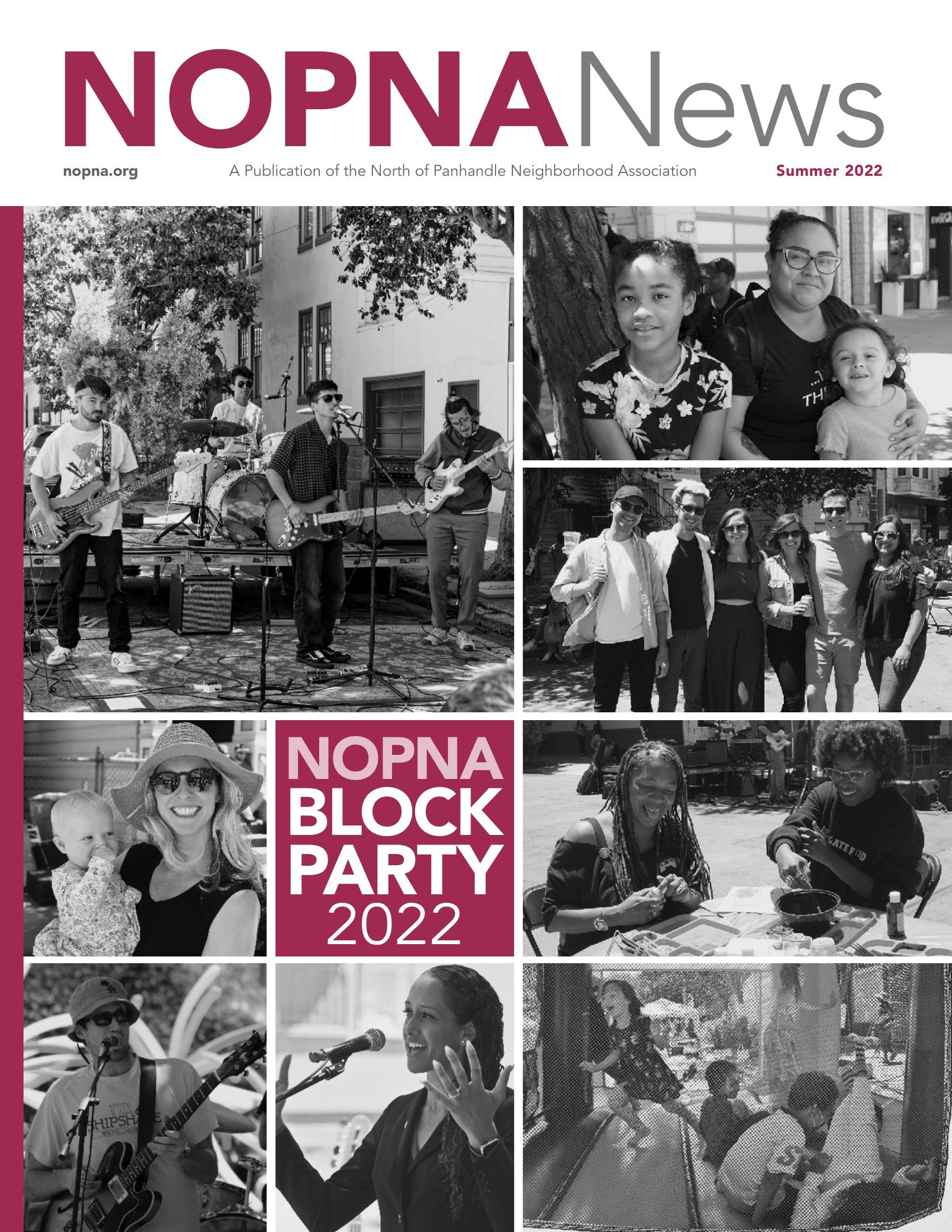
After two very long years off due to COVID-19,
NOPNA reignited the Annual Block Party on Saturday,
July 16th! It was a beautiful day, packed with activities on
Lyon Street between Grove and Fulton. There were
attractions for kids and adults, great live music from
local bands, and even some special “celebrity” guests.
Leela Gill
NOPNA Board Member
Kids delighted bouncing all day in the Big Castle bounce house, got their
faces painted, and contributed to a collaborative chalk mural in the middle
of Lyon Street facilitated by local artist Sasha. Throughout the day, kids and
adults were treated to a variety of music from four bands: The Sunblock
Boys, The Band Ice Cream, The Undercurrent, and Fonsie.
Local elected officials were also sighted that Saturday: newly appointed
District Attorney Brooke Jenkins and State Senator Scott Weiner both mixed
and mingled with the crowd, listening to neighbors and trading ideas.
All these festivities are only possible with the generous support of our
sponsors. As a Platinum sponsor, BASA (Bay Area Safe Alternatives) hosted
a booth that was busy throughout the day. BASA is a dispensary which
prides itself on being a compassion-based enterprise that supplies top-of-
the-line products. Gold sponsors included long-time NOPNA supporters:
Indigo Group Real Estate (Mollie Poe and Declan Hickey) and City Real
i
s
n
k
n
e
J
m
J
i
;
t
a
f
i
Y
;
o
z
z
u
N
e
v
e
t
S
;
t
e
k
c
o
R
M
y
b
s
o
t
o
h
P
y
t
r
a
P
k
c
o
B
l
The NOPNA News is published by the
North of Panhandle Neighborhood
Association for the residents, businesses,
and friends of our neighborhood, which
is bounded by Masonic Avenue and Turk,
Divisadero and Fell Streets.
PUBLISHER
NOPNA Board of Directors
EDITOR IN CHIEF
Jason Cauthen
EDITOR
Emeline Minor
COPY EDITORS
Robin Kutner,
Nathan Lovejoy
LAYOUT AND GRAPHIC DESIGN
Brenda Drake Lesch
DISTRIBUTION
Will Valentine
PRINTING
Image Printing, San Francisco
NOPNA’s Mission: The purpose of
this association shall be to estab-
lish neighborhood unity, maintain
multi-ethnic and multi-cultural
diversity, foster a sense of neigh-
borhood pride, promote a safe and
clean community, and improve the
quality of life for all residents of
the neighborhood.
Your financial support allows NOPNA
to cover the costs of our newsletters,
community building events like
our block party and holiday party,
public art projects in the neighbor-
hood, and other activities that enrich
our dynamic neighborhood.
It also supports this site.
https://www.nopna.org/get-involved
Make a difference on our streets and
become a member today!
Contact NOPNA
issue 1 : 2022 | 3
WHAT HAVE
WE VOICED
IN THE RECENT
ELECTIONS?
Do you sometimes feel like campaign
season never ends? In 2022, we had
elections in February, April, and June. Our next
one is in November. There was also the curious
(and soundly thrashed) 2021 effort to recall
Governor Gavin Newsom.
In February, three SFUSD board members were
up for recall. All three recall efforts succeeded with
city-wide approval for the recall at 76%. The NOPA
neighborhood was only slightly more forgiving and
still voted to recall all three members at 63%.
In April, our neighborhood voted to elect Matt
Haney rather than David Campos to fill state
Assembly District 17 with 63% support for Haney,
almost identical to the SFUSD recall vote.
Two high-profile local propositions in June were
Propositions A (SFMTA funding) and H (District
Attorney recall). Despite support from the Mayor
and all Supervisors, Prop A fell barely short of the
2/3 majority required of bond votes. We NOPA
residents were more supportive of additional MUNI
funding, and supported it at a rate of 79%.
Proposition H was the nationally discussed
proposal to recall Chesa Boudin, the District
Attorney who entered office in 2020. Citywide,
Boudin was successfully recalled with 55% of voters
in favor; our NOPA community had a different take
with only 38% voting in favor of the recall.
The NOPNA Board considers neighborhood
voting records when we choose what to advocate
for. Please vote in every election, no matter
how hyperlocal! There’s one more election in
November, in case you thought you were done for
the year. Voting is a very important responsibility
for society. Our voice is a privilege and it’s
important in maintaining democracy to use our
vote to express that voice. Get out the vote!
Estate (David Cohen and John Dallas). Emporium contributed as
a Silver sponsor and shared a variety of outdoor games for all to
enjoy. Thank you also to Central Coffee, Bob’s Donuts, Souvla,
and Sparky’s Balloons who each contributed in their own way
to enhance the day. Finally, huge thanks to all who volunteered
to help set up the event, monitor traffic, and clean up after
the activities. We also want to thank the many neighbors who
donated to NOPNA during the party.
NOPNA is a 100% volunteer-run non-profit organization that
relies on donations from its community to fund activities, such as
the Annual Block Party, the Halloween Block
Party, the Holiday Party, and the NOPNA News.
We hope to see you at the next one!
Best,
Leela
Sign up for our
email newsletter!
SPONSORS & VOLUNTEERS
PLATINUM
Bay Area Safe
Alternatives (BASA)
GOLD
Indigo Group Real Estate
City Real Estate
SILVER
Emporium
COMMUNITY
CONTRIBUTORS
Central Coffee
Bob’s Donuts Souvla
Sparky’s Balloons
OUR AMAZING VOLUNTEERS: Brooke Bower, Cynthia
Chapman, Garen Checkley, Doug Diboll, Jayasi Mehar, Jeff
Liu-Leyco, M Rocket, Max Almaraz, Quang Duong, Rebecca
Reis, Romil Bhardwaj, Sarah Otis, Steve Nuzzo, Taylor Carden,
Vahini, Yifat Amir
Leela Gill is married with two boys, is a NOPNA board member, and has been
active in safety and community organizing in the neighborhood since 2000.
Tim Hickey and his wife, Leah, have lived in
the neighborhood since 2010 and can be seen with their son,
Liam, biking and walking through the area.
4 | NOPNANews
CONTINUED FROM NOPNA NEWS SPRING 2022
OUR HISTORY IS
NO MYSTERY
In my mission to learn more
about the City College murals
at Masonic and Hayes, I was
introduced to Miranda Bergman
and her long-time collaborator, Jane
Norling. Miranda and Jane are founding
members of the Haight Ashbury
Muralists and the creative forces who
have infused “The People’s Wall”1
with color since the mid 1970s. To my
delight, Miranda kindly suggested I
swing by her residential workshop in
an effort to jump-start the process of
organizing her personal archives, a
process Jane had recently completed
for herself.
American citizens. What I didn’t know
— and what I was seeking to better
understand — was the journey that
brought the wall to life.
I rang Miranda’s doorbell on a
bright January afternoon and was
warmly greeted by a fashionable
septuagenarian with a timeless, down-
to-earth vibe. She settled me into a
nook in her cozy backyard workshop
and left me alone with Triscuit the Cat
and some underground jazz radio while
she disappeared to retrieve her files.
When she returned with a tall, unwieldy
stack, I was thrilled, impressed, and
more than slightly intimidated.
At that point, I knew some high-
One of the earliest documents,
level facts about “Our History Is
No Mystery,” the first of three
murals painted at the site: funding
was established through a federal
bicentennial initiative and scenes
depicted a “people’s history” of the
United States that boldly confronted
a number of uncomfortable realities
such as the internment of Japanese-
minutes from a Haight Ashbury
Improvement Project meeting
hosted at City Hall in the fall of 1974,
unexpectedly brought a smile to
my face. The arcane notes paint a
familiar picture of interest groups and
civil servants duking it out to finalize
the allocation of public resources.
Merchants, represented by the
Improvement Project, believed the
allocation of bicentennial funds
for murals to be excessive. (If I’m
connecting dots correctly with Tim
Drescher’s2 account, they wanted
to paint fire hydrants instead.) The
Muralists, represented by Miranda,
Jane, Arch Williams, and Thomas Kunz,
were able to hold their ground by
promising an endorsement letter from
Supervisor Molinari. I silently celebrated
the big-picture thinking and tenacity of
the underdog artists and I continued
sifting through files.
In documents spanning throughout
Miranda Bergman, one of the founding
members of the Haight Ashbury Muralists.
1975, I saw the Muralists continuing
their crusade by conducting community
outreach and building a broad base
Top: Letter from Jane and Miranda, dated
August 29,1975. Middle: Notice of the
Public Hearing for All interested Artists.
Bottom: About the mural.
issue 1 : 2022 | 5
12. Working people in San Francisco -
women, men and children of many
cultures creating their world.
Scenes from Our History is No Mystery
7. The Great Depression of 1934,
1. Ohlone people, and their
decimation by the Spanish
Missions.
picturing William Randolph Hearst
Sr, who built his castle when
millions were unemployed.
2. Mexican American War, 1846
- 1848: the U.S. seized a large
portion of Northern Territories
part of which became California.
3. The Gold Rush, 1850s: showing
the Chinese labor in the mines
and the booming growth of S.F.
4. Convention in 1850 to demand
that public schools be open to
black children.
5. The Spanish American war of
1898 and the US colonization of
Cuba, the Philippines, and Puerto
Rico. Major shipbuilding for the
war took place in San Francisco.
6. 1906 earthquake and
reconstruction.
8. The San Francisco general strike
of 1934.
9. World War II, showing the
detention in camps of Japanese
Americans, and the large influx
of African Americans to work in
the Hunter’s Point shipyards.
10. The sixties. Times of much
social activism in San Francisco.
Featuring a portrait of imprisoned
leader of the Black liberation
movement, George Jackson.
11. Threatened destruction of the
International Hotel. The Hotel
was destroyed in 1979.
of support for “Our History Is No
Mystery.” A letter from City College
indicates former Director Maxwell
Gillette’s support for a mural on-site,
a public hearing notice encourages
all artists to get involved, an open
house notice invites the public to
review all submitted designs, and a
“Who, What, Why” flyer outlines the
Muralists’ motivations and intent. As I
imagine the creation and distribution
of these documents, composed with
hand-rendered fonts and graphics, it
becomes increasingly clear that “Our
History Is No Mystery” was the result
of a major, multi-faceted effort to
engage the entire community in a
collective work of art.
In the fall of 1975, almost a year after
surmounting the bureaucratic hurdles
at City Hall, the mural evolved from
concept to reality. Jane and Miranda
submitted a sketch of Our History to
City officials for review, accompanied
by an inspiring vision statement:
We are Jane Norling and Miranda
Bergman. . . We chose the John
Adams site because of our respect
for a school that gives free quality
education to all. It is an asset to our
community and we want to help
make it more beautiful . . . We feel
that history is a key to understanding
our times, and so we welcome an
opportunity to present it in a visual
form that can be seen by all, at any
time . . . We hope you like it.
And finally — in May of 1976, after
an almost catastrophic bout of racially-
motivated vandalism — the mural
was completed and dedicated. An
untitled sheet of paper with three typed
paragraphs begins:
We are happy to be having this
celebration today because it is the
birthday of Malcolm X. . .
I smile again as I recognize Miranda’s
opening lines in “The People’s Wall.”1
It’s taken years for the Muralists to
reach this celebratory milestone, and as
the enormity of their life-long labor of
love is beginning to sink in, I realize I’ve
only scraped the surface of their efforts.
I still have two massive file folders to
work through and the winter sunlight
is beginning to wane through the
workshop window.
TO BE CONTINUED
1. Tim Drescher, 1994, San Francisco Murals:
Community Creates Its Muse (Expanded
Edition) Pogo Press
2. “The People’s Wall,” produced by The
Haight Ashbury Film Collective, can be
viewed at
Em Minor has lived in NOPA since 2018 and
enjoys strolling through the Panhandle in the
evenings with her husband John.
49
6 | NOPNANews
by JD Jenkins
FALLEN
Crowds and clouds scudding by
As if nothing happened
Oak and Fell full
Nose first and indifferent
Standing here in Panhandle mud
I live in a fallen Eucalyptus
Sparrows flit in and out
Mourning or rejoicing
We’ll never know
No one heard the night crack
Tucked inside little apartments warm
And dry, blue panels flickering
Wind howling
Coyotes cowering
Pinched yips in the den
Brought down by wind or falling fish
Or the weight of starlight piercing
The satin sack of night
We’ll never really know
Brought down by me by you
Climbing to get a better view
And leave us completely
F
a
l
l
e
n
Does it matter now?
It would have continued falling
Through the leaves of our sheets
Into the places where we dreamt
Rainbow skinned, not a drop of sap
To stick us together
No blood, no weight of one another
Before the yellow tape
Before the chain saws
Before disintegration
I want to see what the sparrows see
I want to see what the crow saw
From the top we never reached
Reaching down I part the branches
And there you are, complete
With the last breath of Spring
JD has lived and loved in San Francisco since 1988. A NOPA resident since
2018, he feels it is the neighborhood that’s been waiting for him to arrive.
LOVE, HONEY,
BEES, AND
MINDFULNESS
I met Jeff
MacMullen
at the Lower
Haight bar,
Danny Coyle.
Upon entering,
I immediately
recognized Jeff from
his We Be Honey
booth at the Sunday
Divisadero Farmers’
Market at the DMV.
“Welcome to my
office!” he said.
Despite this
office being a
neighborhood bar,
complete with the
usual bar-stuff (beer,
darts, football), it’s
clear that Jeff is telling the truth: this is not only his regular
after-work stop, but also his conference room and office.
Jeff’s honey is featured prominently on Danny Coyle’s
menu: Honey Lemonade is on the first page of Danny
Coyle’s menu, as is a hot toddy with honey from Jeff’s
local brand. Jeff speaks fondly of the bar, sharing how the
owner and staff have been good to him while managing
to remain open with outdoor seating throughout the
pandemic. Community is important to Jeff: sharing with
local people and bees.
When the topic turns to bees and honey, Jeff’s demeanor
completely changes. His eyes ignite with passion and
reverence as he talks about bees, pollen, honey, nature,
flavor, and mindfulness.
The respect and wonder with which he speaks of nature
and his work reveals that, to Jeff, honey production is a real
vocation — a true calling, bordering on spiritual practice.
At the risk of sounding overly-dramatic, I would go so far as
to say that hives are Jeff’s temples. The words he uses —
beautiful, brilliant, clever — are spoken with a demeanor that
dances around from joy to delight, then to awe and wonder.
issue 1 : 2022 | 7
We talked about how honey flavor is often a surprise to be
discovered, rather than a product to be controlled. “You’ve
got to taste it to label it!” he says. For example, his prior
week’s batch was flavored with accents of avocado and
hints of sage and eucalyptus. And the terroir of another hive
resulted in a lighter flavor, with subtle hints of wildflower.
Terroir tĕr-wär’ (n): “the complete natural environment,
usually referring to wine production, including soil &
climate.” For honey, the terroir and the flavor is determined
by what the bees are eating. This fall, Jeff’s looking forward
to batches of fennel honey.
Later, we walked to one of his hives, where we discussed
topics ranging from hive dynamics to the agricultural
regulations applicable to local beekeeping and I learned
honey is antibacterial, antifungal and antiviral! We discussed
hive construction and repair, the fact that bees can’t tolerate
rhododendron, and Jeff’s standing offer to remove bee
swarms from properties that don’t want them, or establish
hives on properties that do. (Call him at 415-646-6585 if
either applies to you.)
A neighbor passed by on the sidewalk and, without
even turning their head, shouted, “Don’t give away all your
secrets, Jeff!” This served as more evidence that I was
dealing with a real local artisan, something all communities
should protect and treasure.
I took one last sip of the honey lemonade and prepared
to depart from the bar. Before calling it a night, I asked Jeff
where readers can find him and his products. He is at the
Civic Center Farmers’ Market on Wednesdays, Divisadero
Farmers’ Market on Sundays, and soon to be at Kate’s Cafe.
Crockett Dunn has been a NOPA resident since 2018 and enjoys biking
through the park with his wife Natalie and 10 year old son
8 | NOPNANews
FAREWELL TO HEAVEN
Before settling
L to R: Hadi, Wafa
and Yahya Salih
in NOPA, the
restaurant,
previously called
Yahya Cuisine,
occupied many
other locations.
It was a
moveable feast.
They started
downtown in
1989, offering
Middle Eastern
mesquite-grilled
kebabs with
a California twist. Two years later,
they moved to 9th Avenue in the
Inner Sunset, where the restaurant
operated side by side with their less
formal deli. In 1997, Yahya decided
to explore a new location at Geary
and Montgomery, in the Financial
District, again paired with a café.
Other iterations have included a
location at Van Ness and Union and
even one in Burlingame.
Finally, on July 4, 2009, they opened
in their recent NOPA location. Its name
was taken from that of their daughter,
born in 2004: Jannah, meaning
paradise, or heaven.
Throughout its journey, the
restaurant remained close to its roots,
serving a highly sophisticated form
of Middle Eastern cuisine based on
ancient recipes of Mesopotamia
and the family’s native Iraq. While
some components of their menu,
like hummus, tahini, and bulghur
wheat, are staples of Middle Eastern
cooking, the Salihs prepared them
with special techniques. For example,
they distinguished their dishes by
combining tangy fruit sauces with
vegetables, and grains with meat.
Among their signature recipes were
garbanzo-crust “pizza”; phyllo dough
pockets stuffed with shredded chicken,
rice, raisins, and almonds enhanced
with cardamom-dried apricot sauce;
and dolmas (grape leaf wraps) filled
with meats, rice, and vegetables, and
flavored with tamarind,
allspice, and ginger.
Wafa Salih, co-owner
and manager of Jannah
Restaurant at 1775 Fulton Street,
looks around the spacious, high-
ceilinged room with an expression
both rueful and relieved. She and
her husband, Yahya, have presided
over this location for thirteen years,
but now it is time for them to go.
Sunday, May 22 was Jannah’s last day
of operation.
Those specialties didn’t
catch on right away,
though. On its first day
at the downtown venue,
recalls Yahya, just three
people showed up. A few
more trickled in over the
next few weeks. It was
touch-and-go until an
enthusiastic San Francisco
Chronicle review by food
critic Patricia Unterman
opened the floodgates
and customers began
lining up all along the
street to get in. “That
review changed my life,”
recalls Yahya. “By 7 p.m.
issue 1 : 2022 | 9
on those evenings, not a scrap of food was left!” Since
then, the restaurant has received rave reviews in many
prestigious food and travel magazines.
Like most dining establishments, Jannah navigated
rough waters during COVID, mainly preparing takeaway
packages. Over the past half-year, with the virus relatively
contained, its in-person clientele started drifting back in.
Their son, Hadi, helped handle the workload and managed
the bar. Their dedication created generations of grateful,
faithful patrons.
The Salihs effusively thank all of these patrons, old and
new, institutions as well as individuals. “Almost every
department at the University of San Francisco has held
a special dinner here to celebrate graduation,” exclaims
Wafa proudly. Jannah has hosted innumerable parties, from
weddings to memorial gatherings, for other groups.
Despite their success, or perhaps because of it, the Salih
family has begun to feel the inevitable wear and tear of so
many years of hard work. Additionally, the general economic
downturn has bitten a chunk out of their budget. Wafa has
been postponing needed reconstructive knee surgery for
years. Then, several months ago, they were informed that
the building housing the restaurant had been purchased by
a San Francisco-based property company, Andina Property
LLC, which plans to remodel the entire structure. The
company offered the family the option to continue operating
Jannah in its current location, but at that point they decided
that it was time to withdraw and take a break.
The couple’s long-term plans are uncertain. Wafa says
that they may decide to open a new restaurant eventually.
It is difficult to imagine this creative, energetic team
retiring to a sedentary life. For now, however, they are
looking forward to a well-deserved period of rest and
decompression. After 44 years of delighting San Francisco
diners, that must seem like heaven.
Suzanne Cowan is a long-time NOPA resident and former NOPNA
News editor and Board Member
10 | NOPNANews
THE GENTLE GIANT
OF THE PANHANDLE
i
k
s
n
i
l
o
m
S
.
M
y
b
o
t
o
h
P
Left, View
of Mercy
Terrace from
the GGP
panhandle,
2022.
Below, View
to Southern
Pacific
Hospital’s
west wing
under con-
struction
from GGP
panhandle,
1910.
Each Sunday as I walk along
the path of the Panhandle
toward the DMV parking lot for my
weekly farmers’ market visit, I pass
by the stunning beast of a building
along Fell Street, spanning the entire
city block between Lyon and Baker.
Protected by the tall, ornate iron fence,
I often see the same elderly gentleman
sitting on the portico high above the
street level atop the massive staircase
at the center of the main structure.
Nodding to him a “good day,” I find
myself marveling at intricate details of
this architectural masterpiece, including
its gilded crosses, even though I have
seen them hundreds of times.
My curiosity finally got the better of
me and I did a little laptop sleuthing
to learn more about this building. The
complex was originally built as the
largest, nongovernmental hospital in
the city for the Southern Pacific Railroad
Company. Back in those days, railroad
companies provided an early version
of an employee healthcare plan. With
a portion of earnings withheld from
the workers, along with subsidies paid
by the company, the railroad hospital
provided a lower cost way to deal with
the injuries common in the early railway
industry.
The purchase of the 2.5 acres of land
on the northwest corner of Fell and
Baker was one of the largest real estate
deals in the immediate aftermath of the
1906 earthquake. This plot of land was
to be the new home for the Southern
Pacific Hospital after the one it had
only recently built in the Mission was
destroyed in the big quake. So, in 1909,
the neoclassical structure designed
by Daniel J. Patterson rose up at the
entrance of the panhandle of Golden
Gate Park (see photo).
It must have been healing to the
patients at the time to look out from
their hospital windows, perhaps from
one of the 450 beds, to the trees of
the Panhandle and residents from
the neighborhood strolling along or
resting on a bench in the park, just
as we do today. Behind the main
structure were the social hall, nurse’s
quarters, and the powerhouse. The
eastern annex was added in 1930.
The Southern Pacific Hospital
operated for over 50 years before
transitioning to the Harkness
Community Hospital in 1968
which operated until 1974 when
it closed due to financial woes.
This magnificent pillar of the
community then entered a decade
of abandonment. Mercy Housing,
the present tenant of this structure,
revitalized this sleeping giant into
a subsidized assisted living facility
for seniors with the first occupants
of the 158 residential units gaining
possession through a lottery on
September 6, 1983, for an average
rate of $150 a month. The group
of buildings along Hayes Street,
including the powerhouse and nurses’
quarters, were later converted into
36 affordable housing units called
Mercy Family Plaza. The Mercy
Housing lease runs for 99 years to
maintain this much needed affordable
housing for seniors.
So, the next time you pass by this
gentle giant, wave to its residents
high up on the front portico, or smile
as you pass by the current front door
on Baker Street with its proud
moniker of Mercy Terrace.
Mark Smolinksi is a medical epidemiologist
and long-time NOPA resident, along with his
Bombay and Bengal rescue cats
m
o
c
.
e
n
i
l
d
o
o
H
,
r
e
y
w
a
S
a
a
u
N
y
b
l
l
i
a
t
i
p
s
o
H
c
fi
c
a
P
n
r
e
h
t
u
o
S
f
o
y
r
o
t
s
i
H
e
h
T
;
.
g
r
o
e
g
a
t
i
r
e
h
F
S
,
y
t
n
u
o
B
a
L
y
d
o
o
W
y
b
2
9
1
#
k
r
a
m
d
n
a
L
y
t
i
C
i
:
l
a
t
i
p
s
o
H
c
fi
c
a
P
n
r
e
h
t
u
o
S
:
s
e
c
r
u
o
S
THE PATH TO A SAFER
AND MORE PLEASANT
PANHANDLE CONTINUES
Any stroll along the Panhandle
multi-use path on the north side likely
results in a noticeably less congested
sojourn than it did prior to July 2020.
This is a result of the Fell Street road
diet: a quick-build safety project that
reduced the surface highway from four
vehicle travel lanes to three, improved
crosswalk visibility and safety, and
created a westbound protected
bike lane. The effort has relieved
congestion on the Panhandle multi-
use path.
The San Francisco Municipal
Transportation Agency (SFMTA)
collected speed and vehicle volume
data along Fell Street before the
project was implemented, 6 months
after implementation, and again 12
months after implementation. They
found several positive safety and
efficiency outcomes. Compared to
the state of Fell Street pre-project,
12 months after implementation there
was a 6% reduction in vehicle speeds
and a 31% shift of bicyclists off of the
Panhandle multi-use path and onto
the Fell Street bike lane. There is
also a significant increase in the overall
number of people using the Fell
corridor: 12% more vehicles, ~65%
more pedestrians, and ~40% more
bicyclists.
With these improvements to the
westbound multi-use path, we are
glad to share that, in December
2021, the San Francisco County
Transportation Authority approved
funding to design and complete a
similar project on Oak Street from
Shrader to Baker. This side of the
Panhandle will be more complicated
than Fell: traffic signals along Oak do
not consider bicyclist safety, whereas
Fell already had bicycle-specific
signals built into traffic signals at
Baker, Masonic, and Shrader. With
the upcoming quick-build project,
we expect a further reduction of
congestion and bicyclist speed on
the Panhandle multi-use path. Finally,
now that the JFK Promenade has
been made permanent, there is an
opportunity to improve safety and
comfort of the Stanyan crossing
between the Panhandle and Golden
Gate Park.
Oak, Fell, and Masonic are
categorized as SFMTA “High Injury
Corridors.” This is not a designation
we are proud of, and therefore
the Vision Zero Committee of the
NOPNA Board continues to advocate
to city agencies for drastic safety
and livability improvements around
our Panhandle. We look forward to
collaborating with D5 Supervisor
Preston on Oak Street, as he hopes
to get the quick-build road diet in
the ground by the end of 2022.
Please contact robin@nopna.org
if you’d like to learn more, share
feedback, or get involved with the
VZ team.
Robin Kutner is the Corresponding Secretary on the NOPNA Board. She is extremely
concerned about climate change and Vision Zero street safety and she makes transportation
mode decisions accordingly.
Tim Hickey and his wife, Leah, have lived in the neighborhood since 2010 and can be seen
with their son, Liam, biking and walking through the area.
issue 1 : 2022 | 11
UPCOMING
EVENTS
Sunday Streets Western
Addition: September 18 from
11:00am - 4:00pm on Fillmore
St, Fulton St and Baker St
Brothers for Change Basketball
Tournament: October 15th in
the Panhandle Park
Phoenix Day: Oct 16th from
12:00-5:00pm on Lyon Street
between Fulton and Grove
NOPNA Virtual General Meet-
ing: Third Thursday of even
months. Next meeting: October
20th, 2022 (check nopna.org for
updates)
Bark the Vote: October 22th at
Alamo Square
ASNA Alamo Scare: October
30th at Alamo Square
NOPA Halloween
Extravaganza: October 31 from
6:00 - 8:00pm on Grove Street
(between Central & Baker)
Farmers Market: Sundays
9am–1pm at the DMV Parking
Lot on Broderick & Fell
Email us to get involved:
Street Address
City, State, Zip
Phone Number
Respect the neighborhood, be part of the community
Your Custom Text Here