
-
A Publication of the North of Panhandle Neighborhood Association
NOPNANews
OUT
&
ABOUT
2018 : issue 4
STANDING
THE TEST OF
TIME:
NOPA’S LEGACY
BUSINESSES
i
k
s
n
i
l
i
W
h
p
e
s
o
J
:
S
O
T
O
H
P
i
k
s
n
i
l
i
W
h
p
e
s
o
J
:
O
T
O
H
P
UPCOMING EVENTS
NOPNA HOLIDAY PARTY!
Stay tuned for details!
Jannah - 1775 Fulton
Saturday, December 8th
NOPNA GENERAL MEETING
Oasis Cafe • 901 Divisadero
Thursday, Nov 15th, 2018 - 7pm
Thursday, Jan 17th, 2019 - 7pm
Thursday, Mar 21st, 2019 - 7pm
SFPD PARK STATION COMMUNITY MEETINGS
Park Station Community Room
Second Tuesday each month, 6pm
DIVISADERO FARMERS MARKET
Grove@Divisadero, Sundays, 10am–2pm
PANHANDLE PARK STEWARDS
Second Saturday each month, 9am-12pm
Bulletin Board near Panhandle Playground
Contact us:
board@nopna.org or www.nopna.org
When people tell me they’ve lived in
diner on the corner of Fulton and
the neighborhood a long time I like to
Divisadero with the easy and greasy
challenge them with a bit of trivia. Can
menu and mismatched mugs, which has
you name the three previous BBQ joints
that were at the corner of Divisadero
and Grove? Only about half can name
been in the same location for well over
30 years. Helen Hwang took over the
establishment in 1988 and has run it
one. For those counting, the answers
ever since with a solid ethos: keep the
are Brother in Law’s, Lilly’s, and Da Pitt.
menu simple and the prices low so that
I consider anything that’s been in the
neighborhood longer than me (20+
years) to be “old school.” But there
are fewer venerable businesses that
meet that description than you might
think. Rather than jazz up the new, this
article is a look at a few longstanding
Divisadero favorites that have stood the
test of time.
I started my quest the other morning
at Eddie’s, the battered and beloved
everyone — not just fancy newcomers
— can enjoy a great breakfast. Closing
each day at 3:30, Eddie’s has served
every mayor of San Francisco and
countless regulars and tourists alike.
Says Helen, “We do our best.”
In 1992, long before Bi-Rite and the
new Falletti Foods, Hani Shehadeh
longed for a place to get high quality
organic produce. Having immigrated to
(continued on page 3)
2 | NOPNANews
FROM THE BOARD
As we progress towards the end of the year, there is much to reflect on, and in the midst
Charles Dupigny - NOPNA President
of it all, much to be thankful for.
In 2018, I am thankful for the efforts of the North of Panhandle Neighborhood
Association (NOPNA) board members, for their constant participation, time, and
contribution. In addition, I am also thankful to our volunteers, Divisadero merchants, and
other neighborhood organizations, for our ongoing partnership in sustaining an eclectic
neighborhood.
This year, NOPNA focused on top five priorities (outlined in Issue 1 of the NOPNA
News): Community Events, Financial Stability, Communication/Promotion, Pedestrian
Safety, and Growing the Board. In doing so, we hosted our annual community
events, focused on obtaining community feedback from neighbors, spoke in favor of
“daylighting” for a safer Fell street, and participated in input sessions for a renewed
Panhandle Playground. In addition, we continue to partner with San Francisco’s city
departments to promote neighborhood upkeep and safety, as well as future NOPNA
initiatives.
However, these efforts could not be accomplished without the support and guidance
of neighbors who have participated in the community since NOPNA’s early beginnings.
In recognition of these long-contributing community members, NOPNA partnered with
Supervisor Vallie Brown’s office to honor the following individuals and organizations
with the San Francisco Certificate of Honor. So as we reflect on the year, let’s honor our
neighbors, and let’s encourage the small contributions that can lead to a lasting impact
on the community.
Clockwise from top left , Jim & Suzanne Cowen have been advocates both inside and outside of
the community, and helped in the early days to organize the board and newsletter. Will Valentine
coordinates the delivery of 4,000 copiesof NOPNA News, four times each year. The Oasis Cafe has
always welcomed our neighbors, but has also hosted our neighborhood meetings for many years. The
Divisadero Farmers Market, formed by NOPNA and Alamo Square Neighborhood Association, started
as a creative idea to bring people together; it has been doing so for more than a decade, and brings
healthy foods into our community. Photos by Joseph Wilinski, www.joewilinski.com
The NOPNA News is published by the
North of Panhandle Neighborhood
Association for the residents,
businesses, and friends of our
neighborhood, which is bounded by
Masonic Avenue and Turk, Divisadero
and Fell Streets.
PUBLISHER
NOPNA Board of Directors
EDITOR
Jason Cauthen
LAYOUT AND GRAPHIC DESIGN
Brian Donovan
BUSINESS OUTREACH/ADVERTISING
Carmen Chan
PHOTOGRAPHY
Joseph Wilinski
COPY EDITORS
Nathan Lovejoy
Erika Alexander
Ann Kim
Jessica Stoneman
DISTRIBUTION
Will Valentine
PRINTING
Image Printing, San Francisco
NOPNA’s mission: The purpose
of this association shall be to establish
neighborhood unity, maintain multi-eth-
nic and multi-cultural diversity, foster a
sense of neighborhood pride, promote
a safe and clean community, and
improve the quality of life for all residents
of the neighborhood.
Your financial support allows
NOPNA to cover the costs of our
newsletters, community b u i l d i n g
e v e n t s l i k e o u r b l o c k p a r t y and
holiday party, public art projects in the
neighborhood, and other activities that
enrich our dynamic neighborhood. It
also supports this site.
Make a difference on our streets and
become a member today!
Contact NOPNA
OUT AND ABOUT
(continued)
issue 4 : 2018 | 3
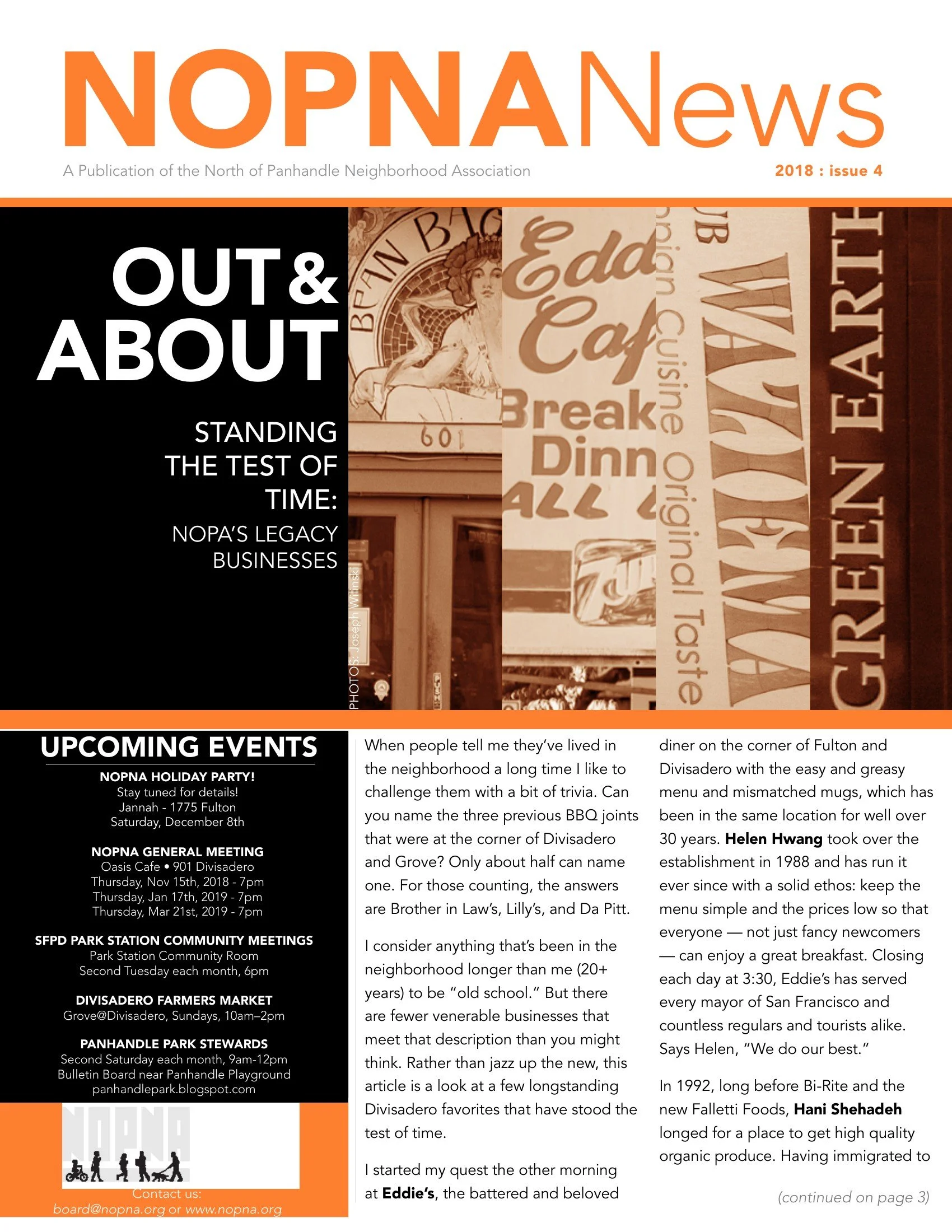
PHOTOS: NOPA’s Legacy Businesses.
Photo Credit: Joseph Wilinski. www.joewilinski.com
the US as a cheese wholesaler in 1977, he’d been
the corner of McAllister and Divisadero. The business
bothered by the low quality fruits and vegetables he
has done well and expanded three times over the years.
encountered in most groceries. So Hani left the cheese
business and started Green Earth Natural Foods on
Asked what the key to longevity has been, Hani replied
simply, “Great support from neighbors.”
Then of course, there’s the Club. Club Waziema that is.
Known as Club Morocco in the 1950s, the Club was a
happening music venue for decades before falling on hard
times for 20 years. It was taken over by Giday Beshue and
Nebiat Tesfazgi in 1999, who kept many of the original
furnishings and the splendid velvet wallpaper in place and
began serving Ethiopian cuisine. The only thing more fun
than eating Ethiopian food in a dive bar is listening the
stories that go along with it. Just ask Giday.
Finally, one of Divisadero’s most revered institutions —
and still home of the neighborhood’s cheapest beer —
is Bean Bag Cafe. Founded in 1993, Bean Bag serves
tasty and affordable breakfast and surprisingly delicious
dinners, always with a smile. I once spent over an hour
on Google Earth attempting to find the street in Paris
that’s depicted on the wall inside Bean Bag. I still haven’t
found it, as it turns out to be fictional. What remains real,
however, is no-nonsense hospitality owner Mike Zagah
has always extended to everyone who walks in the door.
Nick Aster is a 20 year San Francisco resident and media architect with a
strong interest in sustainability and city life.
4 | NOPNANews
Photo Credit: Joseph Wilinski. www.joewilinski.com
THE DIVISADERO MERCHANTS ASSOCIATION GETS FESTIVE
The Divisadero Merchants Association
our vibrant community by lighting
and generosity in contributing funds
is proudly sponsoring holiday lights
up Divisadero Street for the holiday
to make this a reality for 2018. A
on Divisadero Street this holiday
season. We feel that this will not only
few generous donors outside of the
season. The Divisadero Street median
highlight what a great community we
Merchants Association have also
from Haight Street to Golden Gate
have, but also bring us all together
contributed funds for this project. It’s
Avenue will be lit up with festive lights.
as a neighborhood to celebrate the
been a pleasure to see our community
We have been working behind the
season of giving,” says Allyson Jossel,
come together through the holiday
scenes for a few months to get this
co-owner of Nopa and the Holiday
lights.
up and running this season. “There
Lights Committee leader.
are lots of new businesses, increased
foot traffic, and just more happening
in the neighborhood than ever
before. We would love to celebrate
You can reach the Divisadero
We reached out to our member
Merchants Association at
merchants for contributions and have
divisaderomerchantsdma@gmail.com .
been delighted by their enthusiasm
Giselle Gyalzen - is the owner of Rare Device
and is President of the Divisadero Merchants
Association for 2018. She is passionate about
volunteering and contributing to communities.
Pota Perimenis
knows NOPA
#1 NOPA Realtor 2016-2018
415.407.2595
DRE 01117624
d
l
o
S
t
s
u
J
d
l
o
S
t
s
u
J
n
o
o
S
g
n
m
o
C
i
1925 Turk Street
Single Family | $1,495,000
1390 Hayes Street, #3
1 BR Condominium | $975,000
500 Masonic Avenue, #8
1 BR Condominium | $899,000
-
n
e
m
d
i
t
c
a
x
E
.
l
y
n
o
s
e
s
o
p
r
u
p
l
a
n
o
i
t
a
m
r
o
f
n
i
r
o
f
d
e
d
n
e
t
n
i
s
i
i
n
e
r
e
h
d
e
t
n
e
s
e
r
p
l
a
i
r
e
t
a
m
l
l
A
.
s
w
a
l
y
t
i
n
u
t
r
o
p
p
O
g
n
i
s
u
o
H
l
i
a
u
q
E
y
b
s
e
d
b
a
d
n
a
r
e
k
o
r
b
e
t
a
t
s
e
l
a
e
r
d
e
s
n
e
c
i
l
a
s
i
s
s
a
p
m
o
C
.
t
n
e
g
a
e
t
a
t
s
e
l
a
e
r
d
e
s
n
e
c
i
l
a
s
i
r
e
l
l
e
S
.
d
e
t
s
i
l
y
d
a
e
r
l
a
y
t
r
e
p
o
r
p
t
i
c
i
l
o
s
o
t
d
e
d
n
e
t
n
i
t
o
n
s
i
s
i
h
T
.
r
e
e
n
g
n
e
i
r
o
t
c
e
t
i
h
c
r
a
n
a
f
o
i
s
e
c
v
r
e
s
e
h
t
i
g
n
n
a
t
e
r
i
y
b
i
d
e
n
a
t
b
o
e
b
n
a
c
s
n
o
i
s
issue 4 : 2018 | 5
ART IN THE
NEIGHBORHOOD
Many NOPA residents walk down Divisadero Street and
take in the sounds of patrons clinking beer glasses at Bean
Bag Cafe or the scent of fried chicken wafting over from
Popeye’s. When you raise your eyes above street level,
however, you may notice a 3D mural of a wolf’s face, peering
down at passersby at the Hayes Street intersection, in
realistic hues of brown and beige mixing with shocking blues
and reds.
Our neighborhood can thank Portuguese artist and activist,
Bordalo II, for this larger-than-life and futuristic piece.
Bordalo II, also known as Artur Bordalo, exhibited his
signature trash animals at the Heron Arts Gallery this past
February and installed the wolf on Divisadero a few weeks
earlier.
Bordalo II is an artistic pseudonym that pays homage to
Artur’s grandfather, artist Real Bordalo. Artur was born
in Lisbon in 1987 and his early experiences in the city’s
m
o
c
.
i
k
s
n
i
l
i
w
e
o
j
.
w
w
w
.
i
k
s
n
i
l
i
W
h
p
e
s
o
J
:
t
i
d
e
r
C
o
t
o
h
P
underground graffiti culture is evident in the wolf installation
PHOTO: Bordalo II’s work above Divisadero Street.
on Divisadero. He continued his formal artistic education
at the Fine Arts Faculty in Lisbon, where he blended graffiti
with sculptural installations and other artistic media.
Bordalo II uses his art to express his frustration with his
generation, one that he describes as consumeristic, and
to bring awareness to climate change, which is a result of
that wasteful attitude. “With the production of things at
its highest, the production of ‘waste’ and unused objects
is also at its highest. . . . I create, recreate, assemble, and
develop ideas with end-of-life material to try and relate it
to sustainability, ecological, and social awareness.” Bordalo
II uses items that are traditionally discarded or even
harmful to the environment — such as damaged bumpers,
burnt garbage cans, or appliances — and reforms them
into the animals they so often harm: wolves, tigers, birds,
and chimpanzees.
You can follow Bordalo II’s work by visiting http://www.
bordaloii.com/ or on Instagram @b0rdalo_ii
Angeli Agrawal - is a Bay Area native who found out about NOPNA
News by reading it in Matching Half Cafe.
6 | NOPNANews
SUPERVISOR BROWN ON HOUSING, HOMELESS,
AND CLEAN STREETS
Photo Credit: Joseph Wilinski. www.joewilinski.com
Vallie Brown is no stranger to NOPA. Prior to being appointed by Mayor London Breed as the new District 5 supervisor,
she was a neighbor, community organizer, and legislative aide to both Breed and Ross Mirkarimi. She draws on these
experiences when speaking of her vision for NOPA, which centers on three topics: housing, homelessness, and clean
streets.
“We’re in a housing crisis and we need all types of housing to ensure we have choices,” she urged in a recent
conversation. “We need to ensure all new developments feature as much affordable housing as possible without
crushing the project.” By leveraging density bonuses, she pushed two high-profile NOPA developments, at 400 and 650
Divisadero, to raise their inclusionary housing levels to 20% and hopes future developments will achieve 23% inclusionary.
At the same time, she aims to ensure inclusionary units for those at various levels of the average median income (AMI),
primarily 55%, the lowest range. Finally, she plans to use other tools, such as neighborhood preference, condo fees, and
the city’s small site program, to protect renters from displacement and increase the city’s affordable housing funds.
“I can’t go to a community meeting without hearing about the homeless issue,” Brown mentioned, turning her attention
to the area’s homelessness. “Anyone who has lived here a while would agree.” Brown supports the recent conservatorship
legislation passed at the state level and adds, “we’re seeing what the opioid crisis is doing to people.” She sees Prop C as
a critical step to increasing shelter capacity and housing options along with on-site, wrap-around services, a model which
has worked in cities such as New York. Lastly, she adds that this is a regional issue: “We need San Jose, Oakland, other
cities in the Bay area to come together and solve this homeless problem though money and services.”
Clean streets, her third priority, is intertwined with the first two. She sees programs such as once- or twice-monthly dump
days, additional public trash cans, and public education as critical to fighting the neighborhood’s trash problem. She also
raised the idea of neighbors “adopting a block” to increase accountability. For those who say these are city issues, she
says, “We need to have the shared responsibility for making our city better — if we can get people to understand that,
then things will get better.”
Julian Mackie has lived in the neighborhood for two years. When he isn’t working, he’s focused on housing and pedestrian safety.
issue 2 : 2017 | 7
8 | NOPNANews
NOPA’S PARKING PROBLEM
Without too much effort you can probably hear a few of the 500,000 cars that cover San Francisco on any given day.
Combined with the city’s growing density (100,000 new households and 190,000 new jobs in the next 20 years), parking
availability is a critical as ever. In NOPA, safety improvements such as daylighting, infrastructure projects like Masonic
beautification and the traffic circle on Lyon and McAllister, and programs such as Ford Go Bikes frequently involve the
removal of parking spaces, usually in NOPA’s busiest corridors. Additionally, several new planned housing developments
will contribute more new residents than parking spaces. So what does the future of parking look like and what is MTA
doing about it?
To better understand these changing dynamics, the San Francisco Municipal Transit Authority (SFMTA) evaluated its
Residential Parking Program (RPP), including Area Q which encompasses NOPA and Alamo Square. This evaluation
process included data analysis of parking availability and existing trends, a review of city-wide best practices, and public
outreach (including a survey). The result are a number of recommendations approved by the SFMTA Board of Directors
on June 5th. Among the new policies was a limit on the number of permits (one per individual or two per household),
driven by data showing that Area Q included 20% more parking permits than parking spaces. Additional changes
included the elimination of the petition process for families to obtain a parking permit for an in-home care provider and
a new “paid/permit” tool, where “visitors parking in RPP areas would be required to pay, rather than adhere to posted
time limits.”
Outside of the RPP, the program has recently embraced a number of other parking tools, including demand-responsive
pricing, which adjust street-parking rates based on
demand, and pick-up and drop-off zones for ride sharing
services such as Uber and Lyft. The SFMTA views each
of these policies as part of its toolkit aimed at optimizing
parking occupancy rates, creating equitable distribution
of available spots, and limiting the number of cars circling
the block looking for an open spot.
Further research is needed in NOPA to better understand
additional changes which can be made to increase both
on- and off-street parking and to ensure existing parking
spots are available to residents. These changes will be
monitored closely by NOPNA and will be reported as
they are made public.
Julian Mackie has lived in the neighborhood for two years. When he isn’t
working, he’s focused on housing and pedestrian safety.
GREAT GIFTS TASTE GREAT
DOUG DIBOLL: COMMUNITY LEADER AND
UNOFFICIAL LOCAL HISTORIAN
issue 4 : 2018 | 9
Doug Diboll embodies what it means
to be a good neighbor. You can find
him serving as the parking coordinator
for Pacific Primary (a position he’s
held for 11 years) or volunteering at
community events such as the NOPA
Halloween party. Doug’s the type of
guy who doesn’t just sweep the leaves
in front of his house, but in front of all
the houses nearby. He also was the
motivating force behind the recent
History Corner at the Spring Block
Party.
Why did you move to San
Francisco?
I’m from St. Louis and I’m gay — and
being gay there was not such a good
thing thirty years ago. The weather is
also much better here!
m
o
c
.
i
k
s
n
i
l
i
w
e
o
j
.
w
w
w
.
i
k
s
n
i
l
i
W
h
p
e
s
o
J
:
t
i
d
e
r
C
o
t
o
h
P
Doug Diboll brings a vigilant passion as a traffic
monitor, and tireless passion in sustaining a safe
neighborhood.
How did you become the parking
coordinator at Pacific Primary?
There were more safety concerns in the neighborhood and
there was a need for a presence on the street. There was
actually a gang in the neighborhood at that time called the
Central Divisadero Playas — they owned what is now 4505
so you’d go to a coffee shop to get out
or a laundromat to wash your clothes.
Now, there are fewer coffee shops and
laundromats because those units are
more commonly owned by families. So
the density and demographics of the
neighborhood changed quite a bit. If I
saw someone with a stroller thirty years
ago, I’d wonder, “which way to 24th
street?” but now you see tons of kids in
the neighborhood.
Has this area always been known as
NOPA?
No. In fact, when I moved here, the
realtors called it called Hayes Valley.
We were in “the flatlands” — no views
of the ocean, so not many people
wanted to live here. But now with
our walk scores and bike scores, it’s
the primo place to be. I think NOPA
became the official name around 1991.
There are many newcomers to the neighborhood. Is
there a specific community issue you’d like them to be
more aware of?
Litter. One thing many tenants don’t realize is that each
BBQ and used it as a money laundering scheme.
household is eligible for one bulky item collection (of up
What’s been one of the most noticeable changes to the
curb with a “FREE” label, but those items often end up in
to 10 items) per year. The tendency is to put things on the
neighborhood since you’ve lived here?
Many of the three-plexes in this neighborhood used to be
the landfill anyway.
rented out to students at USF or UCSF. There would be
If you’re curious to learn more about San Francisco history,
4–5 people per flat with just the kitchen as common space,
Doug recommends the website www.foundsf.org.
Molly Tobin has lived in NOPA for two years and loves Yoga Garden, Alamo
Square Park, and carnitas burritos from El Rancho Grande.
10 | NOPNANews
MICRO HISTORY
HOME OF THE DEAD
FORD GOBIKE
CONTINUES EXPANSION
As we follow up on the bike share conversation, the
online community forums are abuzz with very small but
very vocal groups of supporters and opponents. Jennifer
Brandl shared survey data from 262 respondents in our
previous issue to help shed some light on this heated
PHOTO: Calvary Cemetery circa 1865; Pt. Lobos Road (now Geary St)
near Presidio Avenue; tollhouse; graves in background. (Photographer
Unknown.) (Marilyn Blaisdell Collection / Courtesy of a Private Collector)
debate. We found that 48% favored continued expansion,
31% favored a moratorium for the remainder of 2018, and
In 1860, NOPA was bordered by two of San Francisco’s
“Big Four” cemeteries: Masonic Cemetery to the west,
along what is now Masonic Avenue, and the enormous
Calvary Cemetery to the north, between what are now
Masonic, Geary, Ellis, and Turk streets. These sprawling
necropolises were part of a mid-19th century garden
cemetery movement. It was a romantic vision that
deemed cultivated “rural” settings, based on English
landscape gardening, more suitable for burials than urban
churchyards.
As San Francisco grew and expanded westward, a conflict
arose over the desire of the living to occupy large plots
of land inhabited by the dead. It was a fight between
respect for the dead and the need to repurpose their real
estate. Ultimately, the living won the argument. But, this
being San Francisco, evicting (most of) the deceased and
relocating them to Colma took 40 years.
It began in 1901, when the city banned further burials
within its limits for sanitation reasons. The first bodies
left the Masonic and Odd Fellows cemeteries in the
1930s (the Odd Fellows Columbarium survives on
Lorraine Court). Laurel Hill was next. Calvary, the Catholic
cemetery, was the last to go. The Archdiocese reluctantly
conceded in 1937 and over the next few years Calvary’s
dead were reinterred at Holy Cross Cemetery in Colma.
What was gained by exiling Calvary’s population to
Colma? The Anza Vista neighborhood, the shopping
center where Target now sits at Geary and Masonic, and
Kaiser Hospital.
Linda Ackerman leads free City Guides tours of NOPA. For the next
tour see http://sfcityguides.org/current_schedule.html.
15% chose “other”, with frequent commentary about the
amount of space taken up by the docks. Rather than leap
into the fray regarding community sentiment, we wanted
to share some new facts and updates.
GoBikes in our neighborhood are regularly used —
comparable to stations in Union Square and Main
Library — with an average 124 rides starting and ending
at the three stations each day. This usage may be
partially attributed to the fact that NOPA has been the
westernmost outpost of GoBikes so far.
Further NOPA GoBike expansion in 2018 has been limited
to an existing red space at Central and Fell (permitted by
the SFMTA without further hearing as does not impact
parking). Additionally, permits were granted for West
NOPA at Grove (west of Masonic) and Fell at Stanyan, with
installation planned for early November.
GoBike will be returning to our community in an
upcoming NOPNA general meeting to share 2019 NOPA
expansion plans, and we look forward to hearing them
share usage data and their final locations after the West
NOPA expansion occurs.
Please continue to provide your input regarding GoBike
expansion to board@nopna.org.
Tim Hickey is a NOPNA Board member, father, and advocate for improved
infrastructure for pedestrians, cyclists, and public transit.
issue 4 : 2018 | 11
GROVE STREET HALLOWEEN PARTY:
ANOTHER “THRILLING” YEAR IN THE BOOKS
It was not your average Wednesday.
On Halloween night, Grove Street transformed from a quiet residential street into a boisterous scene, filled with ghouls
and goblins, ghosts and princesses, clowns and pirates. Families near and far gathered to trick-or-treat in spooky garages
and graveyard gardens. Once again, Grove Street residents pulled out all the stops to welcome and entertain visitors for
NOPA’s annual Halloween party. The variety of creative costumes presented no easy task for the costume contest judges
— District 5 Supervisor Vallie Brown, SFPD Captain Una Bailey, and NOPNA Board President Charles Dupigny — who
awarded Certificates of Honor to the winners.
The NOPNA board extends a huge “thank you” to everyone who helped make the party a success. First and foremost,
we couldn’t have done it without the generous neighbors of Grove Street, who hosted this wonderful tradition. We would
also like to thank the many volunteers who helped monitor the barricades, run candy to houses running low, and help set
up and breakdown the whole event. Thanks also to our VIP judges and the University of San Francisco Dons, who kept the
event fun and lively. Finally, NOPNA thanks neighborhood realtor Jennifer Rosdail for her many years of support.
Only with everyone’s help is this neighborhood tradition possible! Here’s to the kick off of a delightful holiday season.
Meg Rahner is a Pennsylvania native who has lived in NOPA since she moved to San Francisco in 2010. She works for a public relations agency downtown and
recently joined the NOPNA board.
Street Address
City, State, Zip
Phone Number
Respect the neighborhood, be part of the community
Your Custom Text Here